
LexisNexis IDVerse
protecting consumers' identity in an era of industrialised fraud
With crime gangs using AI to create deepfake identities on an unprecedented scale, companies are employing a combination of new technology, analytics and shared data to protect their customers from fraudulent accounts being opened in their names
In spring 2026, a US court convicted the Ukrainian fraudster Yurii Nazarenko for selling more than 10,000 fake digital identity documents, including passports and drivers’ licences, through his website OnlyFake.
This site wasn’t hidden on the dark web. It was easy to find on the regular internet. Nor did the documents cost a fortune – just a few dollars. And while OnlyFake was taken down in 2024, there are plenty more like it. They use generative artificial intelligence to create deepfakes that are so convincing they are only spotted around 20 per cent of the time, according to a recent study by the UK’s Royal Society.
Their outputs are so good that they can pass liveness detection tests designed to determine whether biometrics such as a face or fingerprint come from real people or fake representations. With the addition of stolen or leaked data, fraudsters can create fake documents that match information on official databases. With these documents, fraudsters are opening accounts with telecoms companies, banks, cryptocurrency exchanges and even vehicle rental firms to carry out lucrative scams.
Deepfake scams are just the tip of a global problem that sees organisations lose billions every year to criminals. But it’s not just a financial loss. Those affected risk their reputations too, particularly when fraudsters use the fake IDs to launder money through bank accounts and crypto exchanges.
A marketplace for fraud

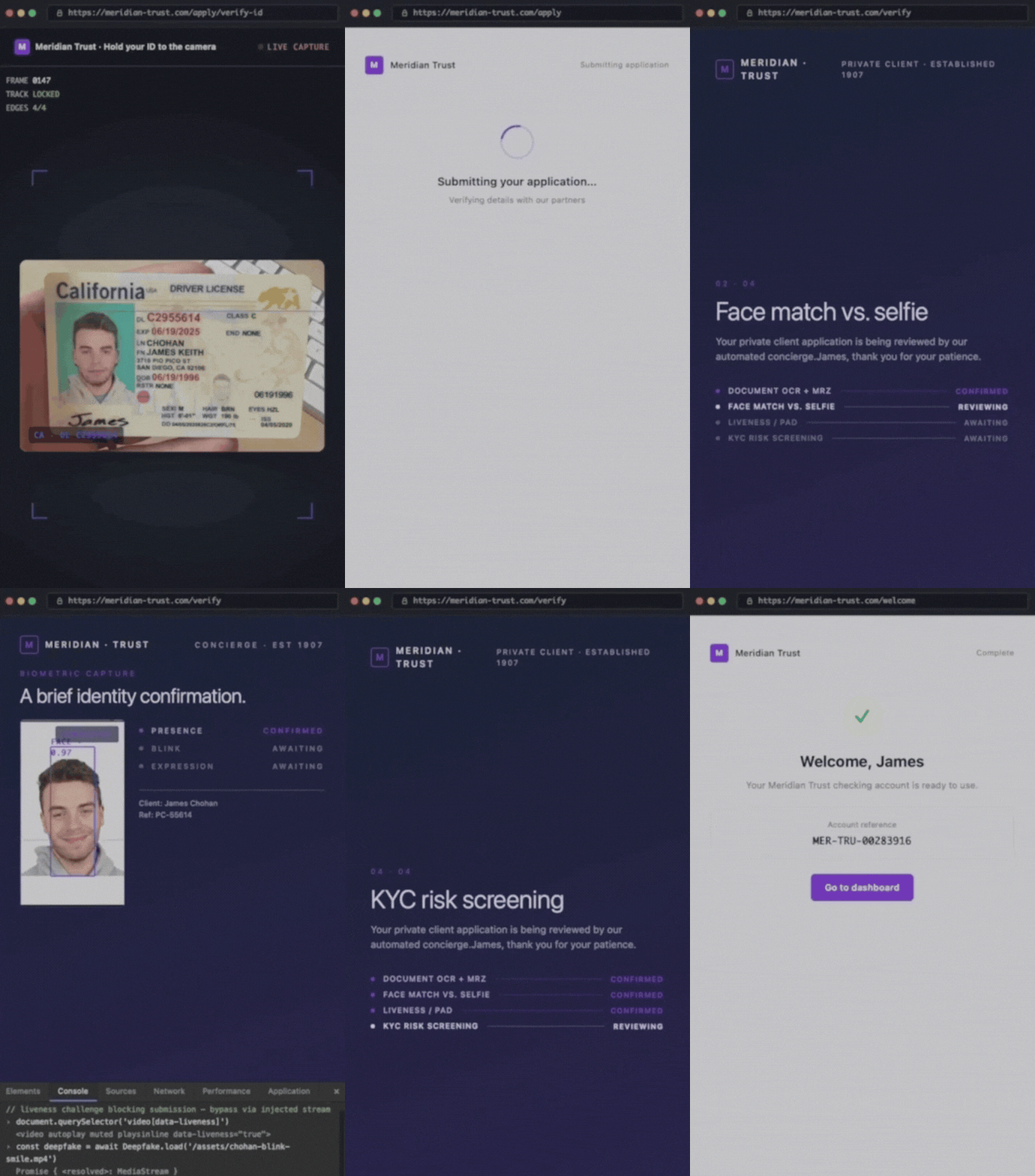
Demonstration of how a fraudster, or an agent, generates a synthetic identity document using a generative AI model. These are fraudulent models, hosted on underground sites.
Demonstration of how a fraudster, or an agent, generates a synthetic identity document using a generative AI model. These are fraudulent models, hosted on underground sites.

Demonstration of how a fraudster, or an agent, generates a synthetic identity document using a generative AI model. These are fraudulent models, hosted on underground sites.
Demonstration of how a fraudster, or an agent, generates a synthetic identity document using a generative AI model. These are fraudulent models, hosted on underground sites.
Key to the criminals’ success is their use of generative AI to mass produce not only highly credible fake IDs for real people, but also fake IDs for fake personas, and fake faces imposed on people to match stolen IDs. Fraudsters are so attuned to their markets that on Nazarenko’s website, they could customise their fake IDs to appear to be a scan or a photograph of a document, depending on the upload requirements of their target. And these fakes are low-cost to produce and can be purchased for as little as 0.99c a piece.
The problem is stoked by the dark web, where a comprehensive fraud-as-a-service marketplace has developed. There, anyone can buy and sell synthetic fake IDs and stolen personal data, as well as find tutorials, ask advice and even apply for a job in the field of fraud.
The result is an explosion in the use of fake IDs. Just five years ago, virtually no forged documents were created using generative AI, then a technology in its infancy. Now, AI tools are fuelling a surge in synthetic identity fraud, which, according to the US Department of Homeland Security, accounted for 85 per cent of all identity fraud by 2024, an almost 50 per cent increase from the previous year. Traditional security tools struggle to keep up with these AI-powered threats, the DHS warned.

These threats are further amplified by organised crime’s use of device or phone farms, where hundreds or even thousands of devices in one location are programmed to open accounts with false IDs.
LexisNexis® IDVerse®, a document authentication and biometric verification solution that is part of LexisNexis Risk Solutions, has seen fraud attempts using false documents triple year-on-year, with the company’s founders saying the trend is accelerating.
As fraud grows, so the targets broaden, with new attack vectors appearing all the time. Besides the well-established modus operandi of opening bank accounts and taking out loans, or opening cell phone accounts with payment plans for the device, the IDVerse® team says fraudsters have also been known to rent cars and vans to remove the engines to sell for thousands of dollars apiece, replacing them with older ones.
Staying ahead of the threat
Australian telecoms giant TPG Telecom’s experience of fraud has followed this trajectory.
Telecom operators sit at a critical intersection of digital commerce and financial services. Many financial institutions rely on mobile devices to help facilitate everyday transactions, making them an attractive target for fraudsters.
Prior to 2019, Vodafone, like all telco operators, was being hit by criminals opening accounts with fake IDs and setting up services for new phones, only to disappear. Fraudsters were also attempting to gain unauthorised access to existing Vodafone customer accounts to obtain additional high-value mobile devices or to take control of mobile services through sophisticated scams and social engineering tactics.
Alicia Croft, Senior Credit and Fraud Analyst at the telco, whose brands include TPG, Vodafone, Felix and Lebara, explains how identity fraud rose up its agenda as the speed, scale and sophistication of the attacks grew.

“We aren’t just combating individuals like John Doe operating from their lounge room, using fraudulently altered driver licences bearing their photograph; we are facing highly automated attacks from sophisticated, global fraud syndicates who are increasingly using generative AI to create fakes that most people wouldn’t be able to spot,” she says.
To better protect their customers, in 2019 TPG signed up to IDVerse to onboard their customers across multiple brands. The software quickly proved itself in terms of efficiency, lack of friction and ease of use: the company’s fraud detection increased by 67% in the first 12 months of implementation.
Within six months of its implementation, TPG saw a decrease in fraudulent activity and a positive return on its investment. “We are protecting our customers from ID theft and misuse, stopping more fraud up front and reducing lost revenue rather than detecting it after it’s happened."
Today, TPG Telecom applies IDVerse across all new Vodafone customer applications to check that every customer is who they claim to be.
The companies have collaborated closely, with IDVerse’s technical team also helping to reconfigure Vodafone’s digital shop journey with performing ID checks at the start of the sales journey rather than at the end. Vodafone’s operational teams are under less pressure due to the removal of manual checks, and, Croft says, the solution’s efficacy at spotting and stopping fraud has given the company greater confidence to innovate in its digital channel.
The ID verification process now takes less than two minutes, with customers happy with the speed and security. IDVerse has helped modernise Vodafone’s identity verification process, reducing the need for traditional practices. By minimising the handling of sensitive ID documentation, they've strengthened security while improving the customer experience.
“The general customer feedback we’ve had has been very positive due to the ease of use and the reassurance that data is encrypted and deleted after use,” says Croft, noting that the company has found it has a lower customer drop-out rate during the ID verification process.
“People are becoming increasingly comfortable with biometric services like smartphone unlocking and banking apps. That familiarity helps us deliver strong risk controls without creating unnecessary friction.”
TPG Telecom also enjoys improved detection of sophisticated fraud attempts because the solution evolves with the threat landscape to stay ahead of the fraudsters.
“Our goal at TPG Telecom is quite simple; protect our customers and enable a secure and seamless experience. IDVerse plays a key role in helping us achieve that.”


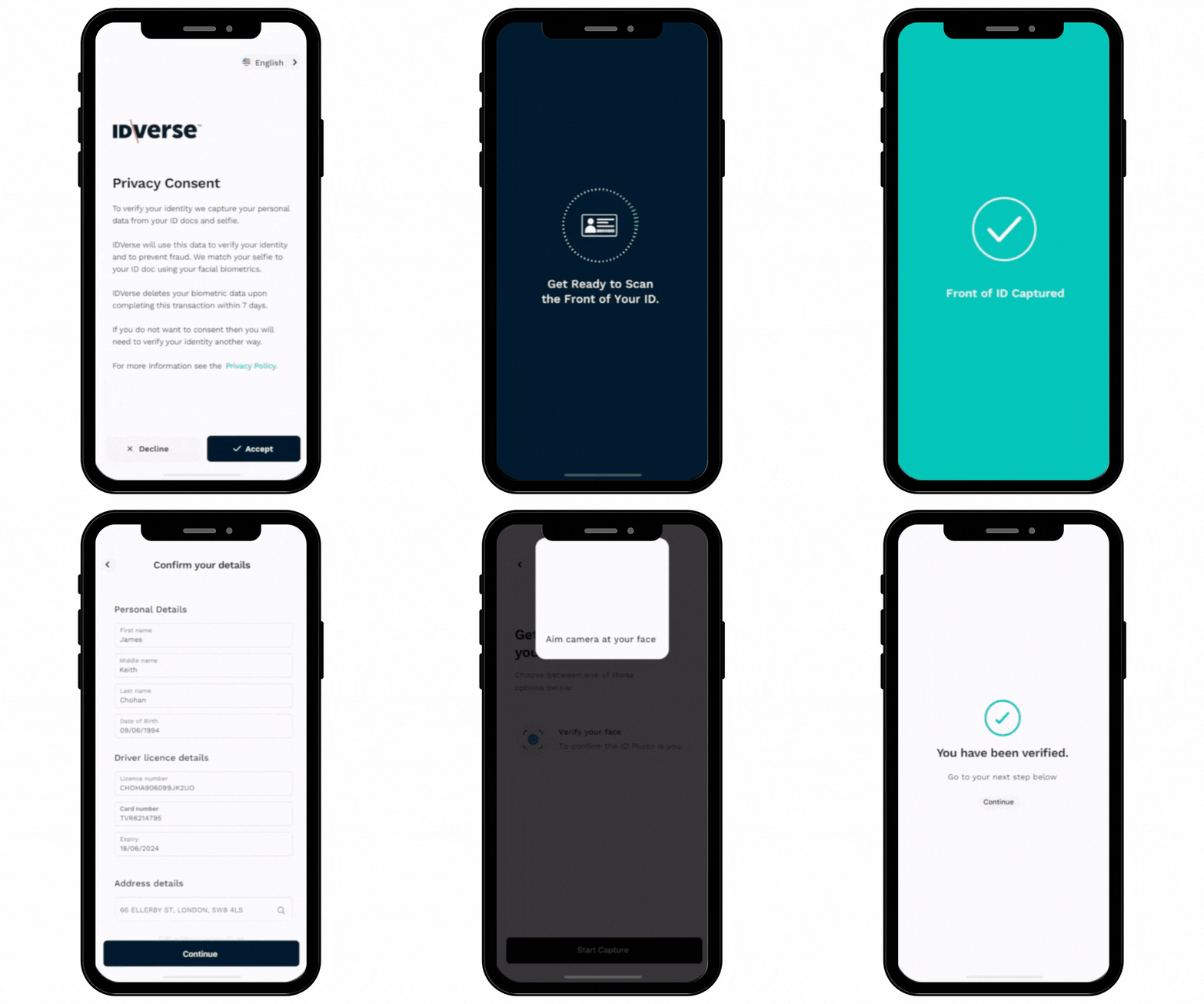
The customer experience flow when using IDVerse
The customer experience flow when using IDVerse
INDEPENDENTLY TESTED AGAINST GenAI FORGERIES. 100% REJECTED.*
*121 fraudulent documents — including organized-crime and GenAI forgeries — independently tested by a FIDO Alliance accredited laboratory. Zero accepted.
IDVerse’s software was so impactful from the start at spotting fake IDs that its first two customers after it was founded in 2016 were the Australian Tax Office and Australia Post.
The organisations signed up following a tender process that included accessing IDVerse’s systems and testing the software. Having such risk-averse and high-profile customers gave IDVerse credibility to attract more, helping the company double in size every year. But whoever the customer is and whatever their size, they are attracted by the company’s extraordinary testing success rate at spotting fraudulent IDs, even as fraudsters’ methods continually evolve with AI.
Just as fraudsters use AI, so does IDVerse. Its cutting-edge document authentication and biometric verification systems use proprietary AI technology and deep neural networks to spot a deepfake within seconds.
The software can detect if the surface of even a digitally presented document has bubbling or is scratched, whether the IP address used to present it matches the location provided, whether the same ID has just been used to open other bank accounts, whether any shadows across it are real and much more.
It also uses behavioural analytics, including whether a user is typing or copy and pasting and whether the user appears to be a simulator rather than a live person. It even evaluates the way the user looks into the camera.
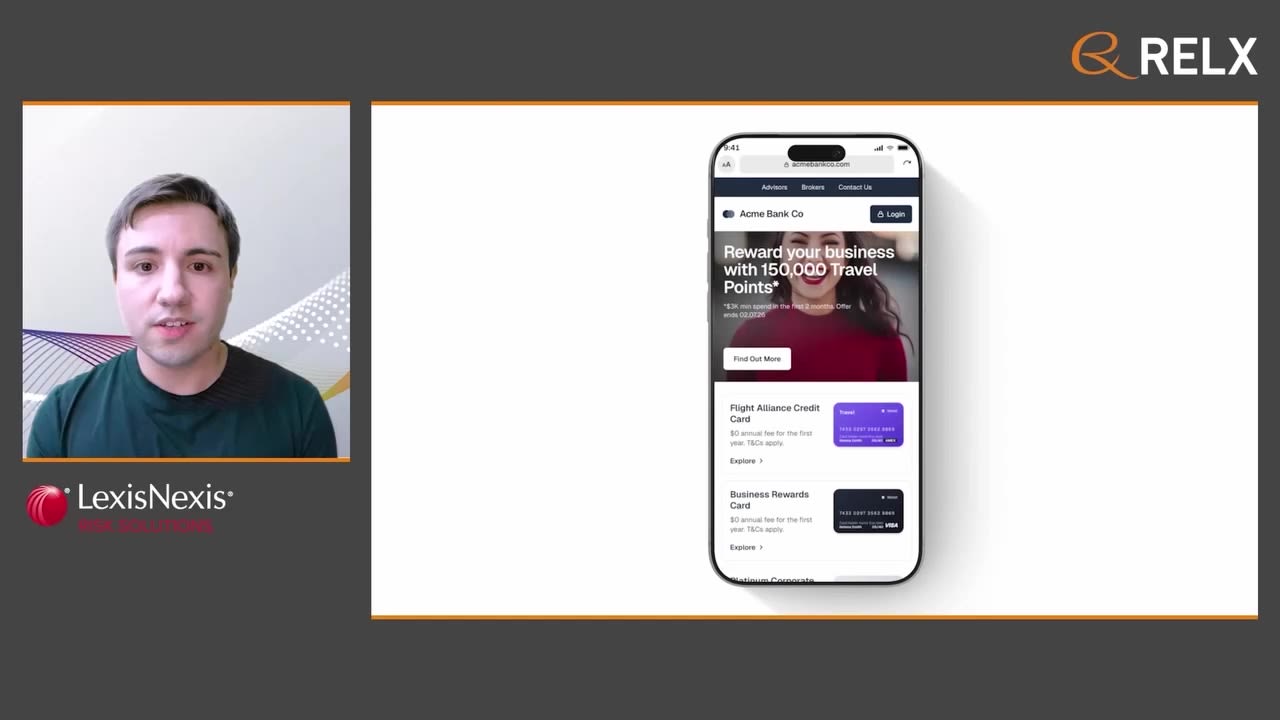
Dan Aiello, co-founder of IDVerse, explains how the tool reduces friction for customers
Dan Aiello, co-founder of IDVerse, explains how the tool reduces friction for customers
“It hurts when a fraud beats us, so we put every single drop of our effort into making sure we’re on top of it. We’re now at a point where our solution far exceeds any human capability of spotting and understanding a fraud and any patterns.”
Thresholds for risk can also be adjusted according to a customer’s appetite and as soon as a new fraud vector is detected, or a different type of fake ID used, the system automatically picks it up. This information is then available across the company’s network within a day.
In addition, the software can crosscheck information against government databases in 230 countries and territories and is smart enough to recognise someone who has shaved off their beard, changed the colour of the hair, or gained or lost weight since the original picture was logged.
Increasingly, it is being used not only for onboarding new customers, but also for reauthentication, particularly for high-risk activities including changing passwords and adding a new beneficiary to an account. In this way it is gradually replacing one-time passwords and two-factor authentication.
“IDVerse gets rid of a load of friction that wasn’t particularly effective anyway,” says Matt Adams, co-founder. “It quickly checks your face and you’re verified instantly. Our customers know you are definitely who you say you are.”
A global battle against fraud
Acquired by RELX in 2024 to strengthen its business risk offer, IDVerse has become part of the LexisNexis Risk Solutions family and is available as a fully integrated solution or as software-as-a-service.
“ID verification is integral now to so many companies’ processes and everything starts with the ID document. But there is no one magic bullet to detecting fraud and preventing it. We believe you need a layered approach,” explains Kimberly Sutherland, global head of fraud and identity at LexisNexis Risk Solutions.
Kimberly Sutherland leading the session: “Battling the Global Scamdemic: Trace the Data, Disrupt the Network!” at the Women in Data Flagship Event 2026
Kimberly Sutherland leading the session: “Battling the Global Scamdemic: Trace the Data, Disrupt the Network!” at the Women in Data Flagship Event 2026
IDVerse works with LexisNexis’ digital intelligence solutions to validate the device presenting a document, as well as the face and ID. It looks at how the device is being used – a static one might suggest a device farm, for example – as well as behavioural analytics focusing on anything unusual such as the IP address, time of interaction and regularity of interaction. It also examines how the proof of ID is being presented, for example as a document in front of a camera, a photograph or a digital version.
LexisNexis keeps a close eye on the ever-growing issue of data protection, making sure that its customers only use the data collected for legitimate and specific purposes. “That’s why we require every organisation we work with to disclose exactly how they’ll be using the data before we sign the contract. We also make it easy for consumers to access their data to correct inaccuracies and request it is deleted,” says Sutherland.
LexisNexis Risk Solutions processes roughly 145bn unique digital transactions annually. Each time the organisation learns something new, it shares it across its intelligence network.
“We know that shared intelligence is extremely effective in helping to detect and prevent fraud,” says Sutherland, adding that the company works across industries and geographies to share intelligence in a compliant manner. LexisNexis Risk Solutions has already set up consortia to drive intelligence sharing in nine countries and has plans to double consortium development activity in the next year.
The organisation also shares its knowledge about how to set up anti-fraud systems and sends professional services teams on secondment to supplement customer fraud teams.
In future, it sees more sharing, more layers, more integration.
“Helping our customers find safe ways to share fraud signals and stop the criminals is a top priority for all of our solutions.”
Looking ahead, Sutherland notes that fraud is a lucrative business for criminals, larger than many country GDPs. She warns: “Their methods will continue to evolve as new technology allows, so businesses must leverage as many risk signals as possible in real time. Incorporate AI in your processes to more effectively check along the whole customer life cycle, from onboarding to account use – all the touchpoints.”

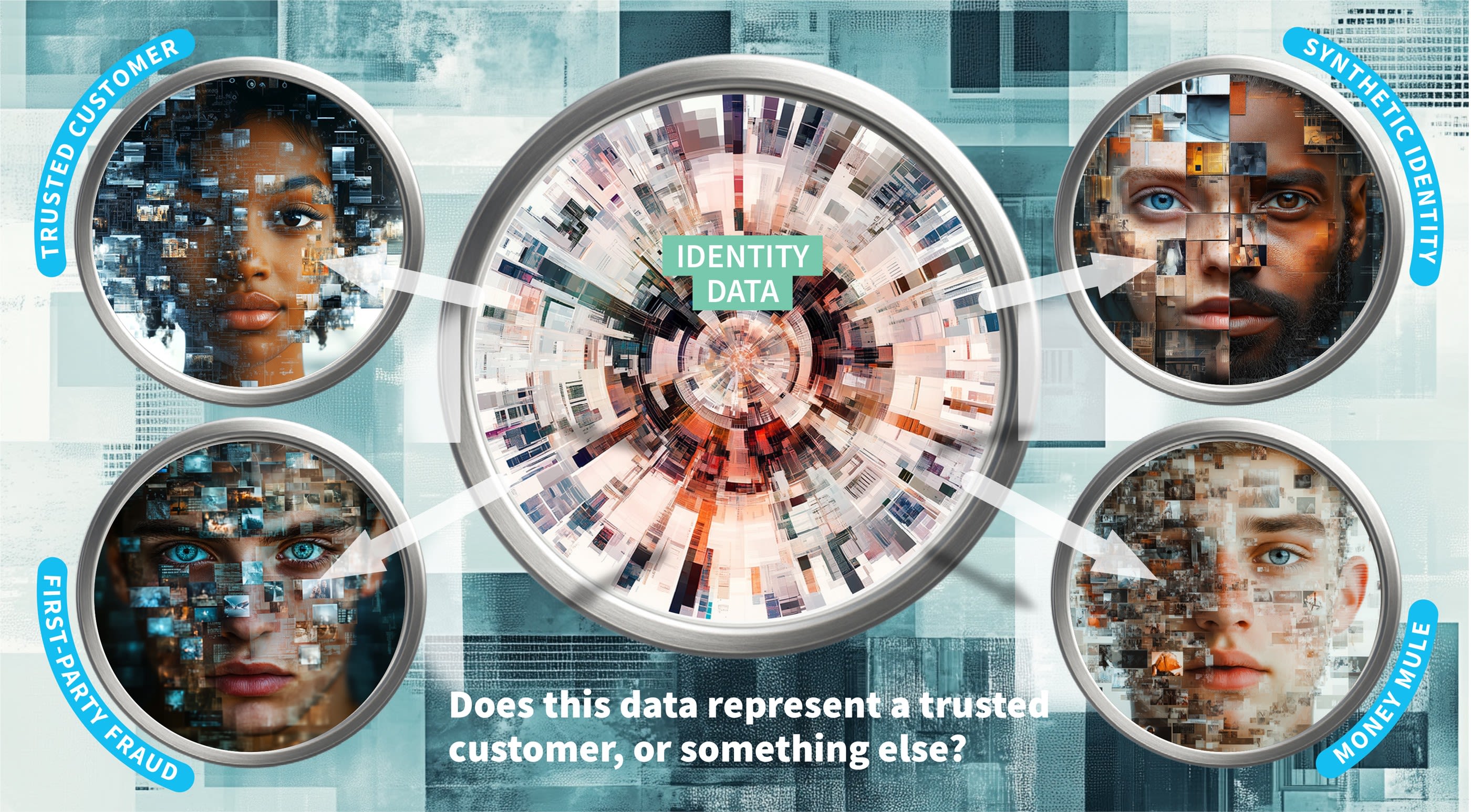
It’s critical to have breadth and depth of data, but a sea of disjointed identity signals can be too scattered for human teams to process in real-time. AI-powered tools and analysis can help decipher and resolve them.
It’s critical to have breadth and depth of data, but a sea of disjointed identity signals can be too scattered for human teams to process in real-time. AI-powered tools and analysis can help decipher and resolve them.

Businesses run on trust. As identity grows more complex, organisations need strong data, advanced analytics, and collaboration to combat threats and succeed. This report from LexisNexis Risk Solutions dives deep into these challenges, and explores how organisations are responding.
Businesses run on trust. As identity grows more complex, organisations need strong data, advanced analytics, and collaboration to combat threats and succeed. This report from LexisNexis Risk Solutions dives deep into these challenges, and explores how organisations are responding.